Go Behind the Scenes
Understanding the Adaptation Process
Reimagining a Victorian bestseller for a new visual medium.
How do you bring a nineteenth-century novel into a medium that asks readers to look as well as read? Adapting The Mystery of a Hansom Cab is not simply a matter of illustrating its most memorable scenes. A prose narrator can describe a street, explain a hesitation or direct attention towards a clue. Comics must distribute that work between words, pictures and the spaces of the page.
For Luke C Jackson and Jake Girard, the guiding concern is Melbourne itself: not just recognisable landmarks, but the feeling of inhabiting a particular world. The adaptation keeps that ambition while reconsidering how Hume’s city and its people appear to contemporary readers.
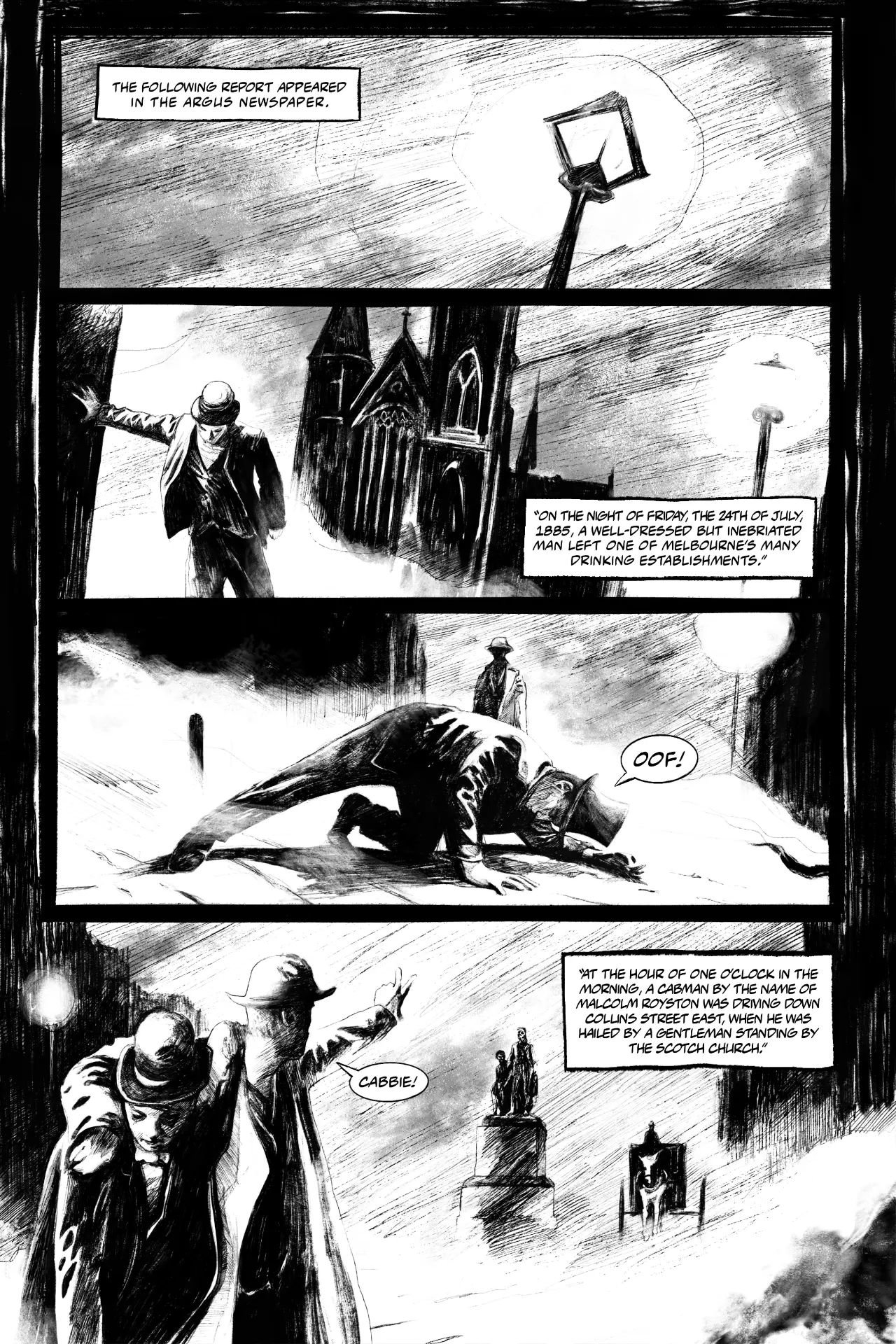
Melbourne as a Character
Hume’s Melbourne is a city of contrasts. Comfortable drawing rooms, exclusive institutions and narrow lanes belong to the same metropolis, yet their inhabitants experience very different worlds. The investigation crosses these boundaries, exposing the uneasy relationships between public respectability, private secrets and social exclusion. Place is therefore part of the mystery’s structure, not scenery behind it.
Literary sense of place combines geography with history, culture, attitudes and emotional connections. Translating that into comics requires more than drawing accurate buildings. Architecture, the distance between figures, light and the arrangement of panels can convey who belongs in a space, who controls it and who feels unwelcome. Melbourne becomes something readers encounter spatially as well as narratively.
Adaptation Is Not Simply Reproduction
Fidelity can sound like the natural measure of an adaptation: how closely does it follow the original? That measure is not enough on its own. A different medium offers different possibilities, and a later audience brings different expectations. Compression, expansion or reframing can be creative responses to those changes rather than evidence that a source has been misunderstood.
Jackson and Girard favour nuance and realism over some of Hume’s melodramatic characterisations. This is not a simplified version of the novel. It is an interpretation that can question assumptions within it, particularly the division between respectable society and the urban poor. Respect for a story need not require reproducing every judgement made by its nineteenth-century narrator.
An Urban Gothic Aesthetic
Urban Gothic is the adaptation’s guiding aesthetic. Gothic fiction’s threatening spaces and returning secrets move from remote castles into the modern city. Stark black-and-white illustration, gritty linework and emphatic shadows turn Melbourne’s architecture into a source of unease. Social power acquires a visible shape.
The Antipodean Club offers a revealing example. Girard depicts it as a dark, gargoyle-adorned building rising above Detective Kilsip, almost an urban castle. Its illuminated windows remain high above the street. That imposing presence belongs with the exclusivity of the club’s members: mystery does not belong only to supposedly dangerous lanes, but also to institutions that guard wealth and influence.
The Language of Comics
A comics page is both a sequence and a composition. Readers move between panels while also registering the whole arrangement. In the Club scene, the building occupies one side of the page; three smaller panels stack beside it. The contrast joins an overwhelming architectural presence to fragments of conversation, making visual scale and juxtaposition part of the storytelling.
The courtroom scenes use another rhythm. Vertical panels recall the court’s architecture and separate its social actors. Heavy black framing and variations in panel height establish barriers around the questioning of Mrs Sampson. Darkness spreads from the shadow of the reporter Rolleston’s hand across his paper and the surrounding page, suggesting that apparent order remains vulnerable to disorder.
Text and image work together to guide attention, pace an exchange and establish perspective. Speech and narration require the reader to scan between questions and answers, while page layout determines how those moments sit beside one another. A double-page spread can extend that spatial experience further, departing from familiar reading patterns rather than merely providing a larger illustration.
Reimagining Little Lon
Little Lon is where the adaptation most clearly reconsiders Hume’s social vision. The neighbourhood had its own economy, culture and history rather than being a collection of grotesque figures. In the spread showing Calton and Kilsip entering the district, a real map contrasts with a deliberately disorienting arrangement of framed street vignettes.
Lantern-lit residents look back at the visitors and, by extension, at the reader. That returned gaze is an assertion of agency: the inhabitants are not passive objects of inspection. Mother Guttersnipe is also reframed through work. A cooking pot initially suggests something sinister, but animal bones and hanging tallow candles reveal a practical enterprise. Those candles are best read as supply for the poor: an inference rather than a documented biography of a real resident.
Explore Little Lon’s history →Research Behind the Adaptation
These choices connect creative practice with scholarship. This essay grows out of Jackson’s creative-arts doctoral work, which examines finished pages through adaptation theory, comics studies and research into place. The account of Little Lon draws on historical and archaeological scholarship that complicates older slum stereotypes.
The result is a distinct storyworld, recognisably connected to Hume’s Melbourne without being bound by all its assumptions. Words, pictures and page space do not merely carry an inherited plot: they offer new ways to encounter it. Reading the published research alongside the graphic novel makes those decisions visible, inviting attention to how a place is made on the page.
Discover Hume’s Melbourne in a new hardcover graphic novel.
Order the Hardcover