Explore the History
Little Lon: Beyond the Slums
The real lives and hidden histories of nineteenth-century Melbourne’s most notorious neighbourhood.
For many nineteenth-century Melburnians, “Little Lon” stood for everything respectable society feared: poverty, vice, disease and crime. That reputation was not invented from nothing; residents faced crowding, poor sanitation and hardship. Yet it was only part of the story. Historians and archaeologists have since recovered a neighbourhood of households, workplaces, children, migrants and individual lives.
The Neighbourhood
Little Lon was the colloquial name for the district around Little Lonsdale Street in central Melbourne. Museums Victoria identifies the excavated area as the inner-city block bounded by Lonsdale, Exhibition, Little Lonsdale and Spring Streets, later known as the Commonwealth Block.
During the middle and later nineteenth century it developed as a predominantly working-class district. Simple houses and small properties were packed along a network of narrow laneways. Cottage industries, small businesses, hotels and later factories operated among homes. Crowding and unsanitary conditions were real, but so were the efforts of people to make a living there.
A Notorious Reputation
In the public imagination, Little Lon became shorthand for a slum riddled with poverty, prostitution and addiction. It was Melbourne’s red-light district, and reports of crime and disorder reinforced its notoriety.
Such descriptions, however, were usually written by outsiders: journalists, officials, reformers and novelists. They could document genuine problems, but they also turned poor and transient residents into a single disreputable mass. Museums Victoria notes that the poverty, limited literacy and mobility of the local population contributed to this reputation. Distinguishing conditions from caricature means reading these sources alongside other evidence.
The People of Little Lon
Little Lon was home to some of Melbourne’s poorest residents and to newly arrived immigrants, including people from Ireland, Italy, China and Syria. Museums Victoria emphasises that, in adverse conditions, many residents still made homes, raised children and established businesses.
The Maloney family of Casselden Place illustrates this continuity. John Maloney, an Irish labourer from County Clare, bought a small three-room wooden cottage there in 1855 after time on the goldfields. Several siblings lived in the street over a forty-six-year period; his brother Thomas ran a carting business from home.
Local commerce was varied. Shops sold food and “fancy goods”, while workshops made items including furniture, bellows and waterproof clothing. Hotels and brothels were also numerous. Much domestic and informal work left few written records, which is why surviving objects matter. Recognising this activity does not romanticise poverty; it acknowledges residents as people managing difficult lives.
The Women of Little Lon
The publisher’s account of Minchinton’s research notes that leading brothels were usually managed by women and that the trade had connections with police and political leaders. This complicates any simple picture of a marginal world wholly separate from respectable Melbourne. Recovering names and individual circumstances helps historians examine economic opportunity, social condemnation and unequal power, rather than allowing notoriety to stand in for explanation.
Women’s lives are central to Little Lon’s history. Some kept households, raised children, took in work or ran businesses. Others worked in the sex trade, whether on the streets or in brothels. Nineteenth-century commentators often reduced these women to moral warnings, leaving their names, relationships and later lives largely unexamined.
Recent historical work seeks to restore individuality without excusing exploitation or ignoring hardship. According to its publisher, Barbara Minchinton’s The Women of Little Lon asks who these women were, how they lived and what became of them. It considers the “flash madams”, the women who worked for them and those who solicited on the streets, drawing on archaeological findings, rare archival material and family records.
Archaeology and Rediscovery
In 1948 the Commonwealth Government acquired the land, and its homes and factories were later demolished. Ahead of new development, archaeologists began excavating in the summer of 1987–88. Further investigations followed, including at Casselden Place. Together, the digs have produced around half a million artefacts, most now cared for by Museums Victoria.
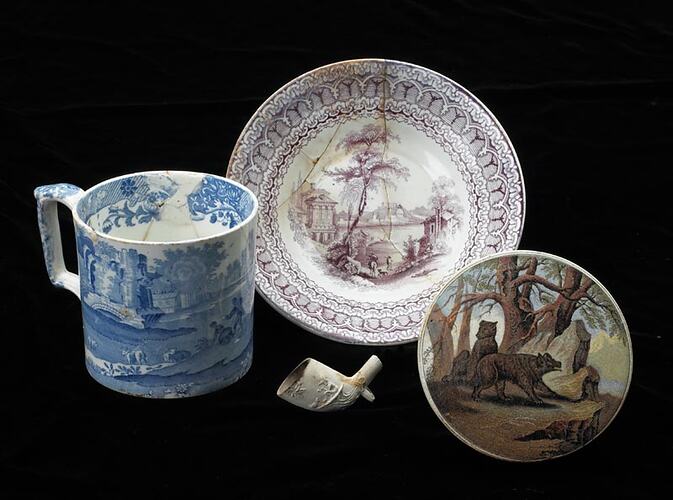
The finds include ceramics, bottles, marbles, toy tea sets, dolls, jewellery, medicines and food remains. From the Maloney cesspit came flawed china seconds alongside older Spode pieces and Staffordshire figures, which museum researchers interpret as evidence of care for respectability and some disposable income. Lace bobbins and sewing tools suggest domestic work that documents rarely recorded. Objects cannot recover everything, but they complicate the stereotype of a uniformly degraded slum.
Little Lon in The Mystery of a Hansom Cab
In Hume’s novel, the barrister Calton and Detective Kilsip enter the district’s lanes to visit Mother Guttersnipe, a key figure in the investigation. Hume renders the area as dark, confusing and threatening, and describes many inhabitants through grotesque and animalistic imagery. This is fiction shaped by middle-class anxieties, not a reliable record of residents. The Australian Dictionary of Biography notes that Hume drew his low-life scenes from his knowledge of Little Bourke Street, another reason to treat the novel’s geography and characters cautiously.
The graphic novel adaptation takes a different approach. Drawing on the historical revaluation of Little Lon, the research article describes a neighbourhood shown with its own culture and economy. Residents return the gaze of the investigators, and Mother Guttersnipe is presented through her enterprise as well as her role in the mystery. These are creative choices within fiction, informed by history rather than claims about a particular real person.
See how the adaptation reimagines Little Lon →Discovering Little Lon Today
Little Lon’s history continues to be interpreted through museum collections, archaeological reports and historical research. Museums Victoria’s online collection makes many artefacts and research articles publicly accessible, allowing anyone to explore objects from the excavations and the stories attached to them.
The street names remain part of central Melbourne, but the nineteenth-century houses and factories of the excavated block were demolished. The best surviving evidence is therefore the record assembled by researchers and the objects residents left behind.
Further reading and sources
- [1] Charlotte H. Smith, “Little Lon”. Museums Victoria Collections.
- [2] Little Lon Collection. Museums Victoria Collections: site history and excavations.
- [3] An Archaeological Time Capsule: Casselden Place. Museums Victoria Collections: the Maloney family assemblage.
- [4] Barbara Minchinton, The Women of Little Lon. La Trobe University Press, Black Inc., 2021.
- [5] Scissors, circa 1880, excavated at Casselden Place. Museums Victoria Collections: work and commerce in Little Lon.
- [6] Reimagining literary sense of place in a prose-to-comics adaptation. Jackson, Le Rossignol and West, New Writing (2026).
- [7] Fergusson Wright (Fergus) Hume (1859–1932). Australian Dictionary of Biography.
Discover Hume’s Melbourne in a new hardcover graphic novel.
Order the Hardcover